RxReality
An ICU pharmacy sim now used to train PharmD students at UGA
June 2024 – May 2025
In the ICU, the critical care pharmacist is a key part of the healthcare team: managing complex medication regimens, preventing errors, and helping save lives. But students training to become ICU pharmacists rarely get the chance to practice on real, life-threatening cases; the stakes are simply too high.
That gap is a persistent challenge for critical care faculty. As a result, we built a 3D simulation using React Three Fiber that lets students freely navigate and interact with an ICU environment, with an OpenAI integration providing customizable feedback on their decisions.
The tool is now actively used to train PharmD (Doctor of Pharmacy) students at the University of Georgia College of Pharmacy in the Critical Care Elective.
My role
Our graduate capstone team consisted of three people. My role was leading the user research and experience design efforts.
Our challenge
Pharmacy students preparing for critical care often find themselves caught between theory and practice. They haven't had many chances to apply their knowledge in a fast-moving, complex, high-stakes environment like an actual ICU.
Our client, the UGA College of Pharmacy, began with paper-based assessments to test student learning. Then, in 2015, they developed 2D modules that let students click around and view static screens. Useful for step-by-step walkthroughs, but we felt we could take the learning experience a step further by making it more dynamic and immersive.
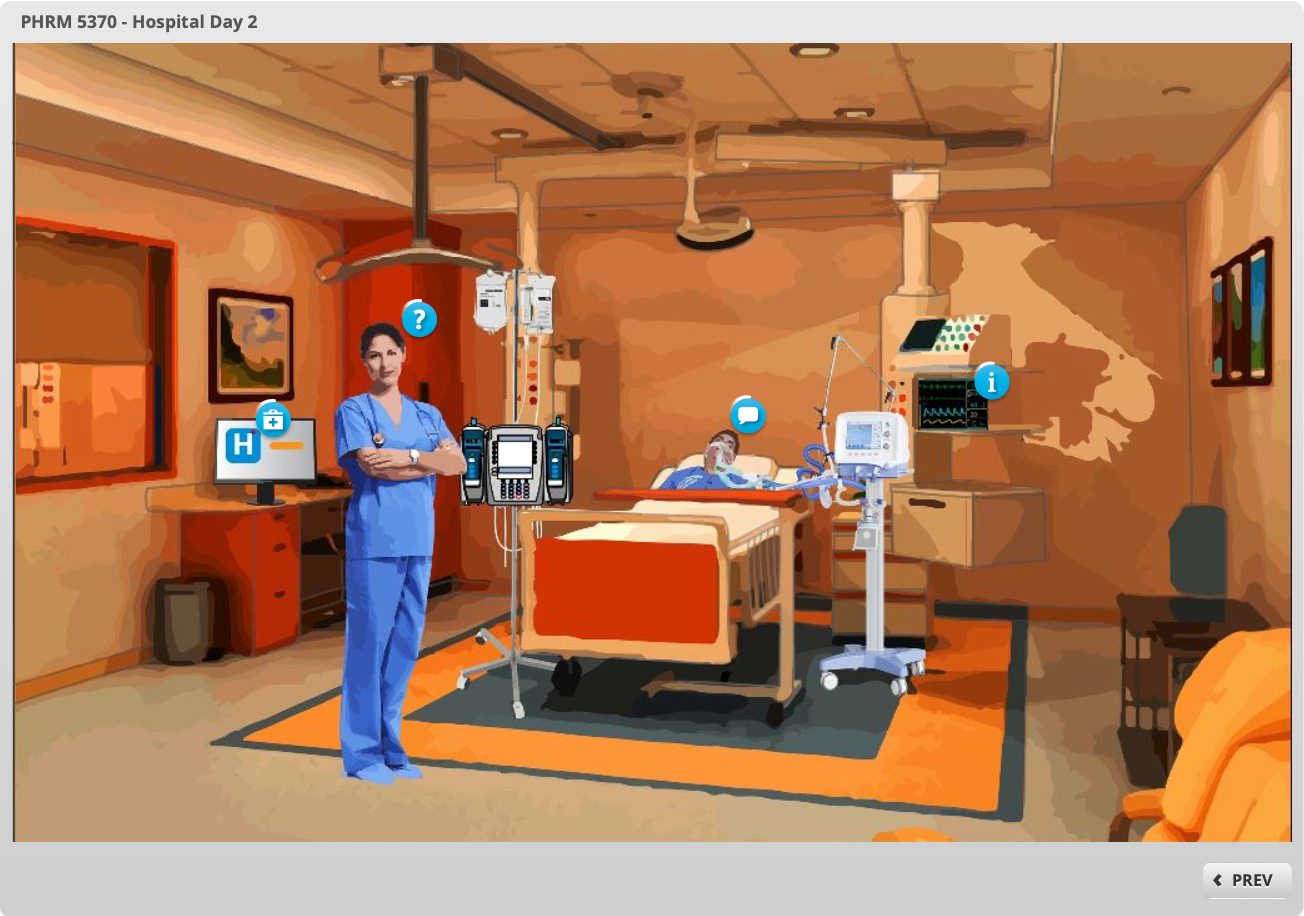
PHRM 5370: the 2D module students used before RxReality
Our process
The path to creating a fully immersive 3D web experience for such a niche target user base required many rounds of research, planning, and careful iteration. We began with discovery interviews across students, doctors, and VR specialists.
After narrowing in on what our users needed, we identified three value propositions to drive the development of our product, drawing inspiration from an assortment of real-world references.
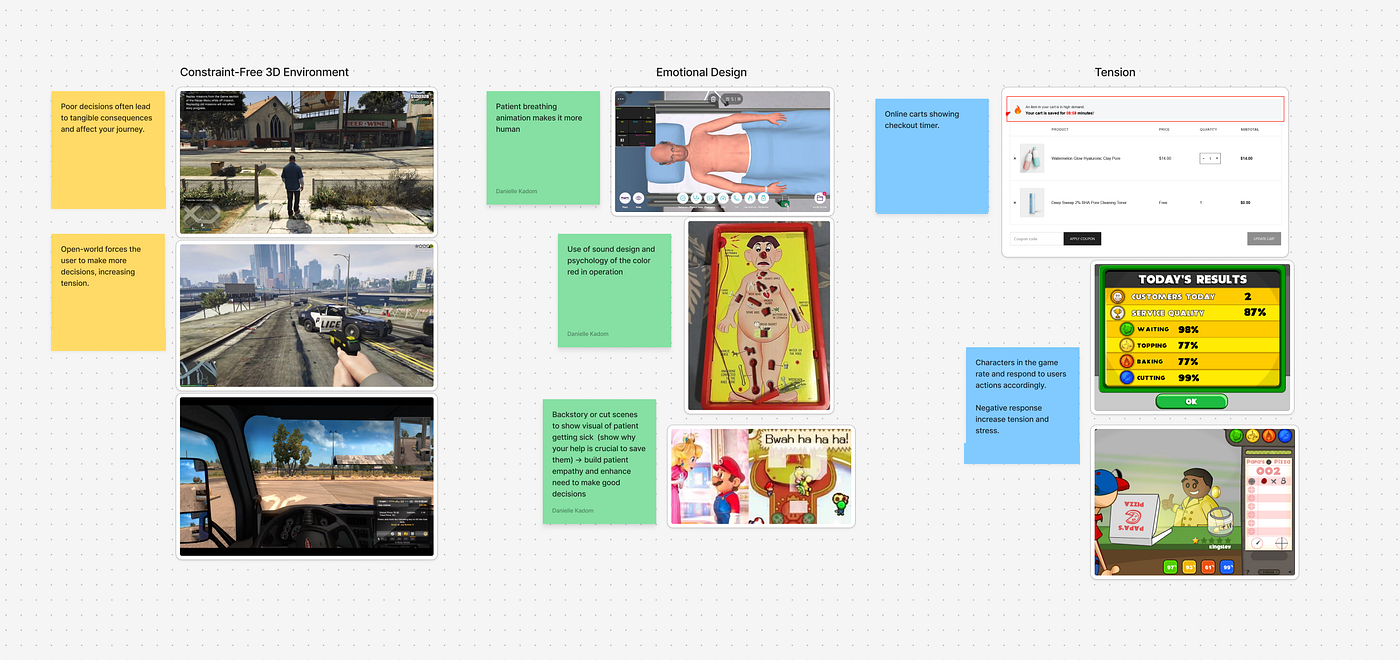
Next, we turned our ideas into a flat, 2-dimensional rapid prototype to get quick feedback from users. Our next step was to begin building the actual 3D environment, by far the longest step of the process. Along the way, we continued to test the state of the product with real users, gathering feedback to inform every iteration.
Final product
After 10 months of design, development, and iteration, we created a fully functional simulation that brings together structured clinical reasoning, AI-powered feedback, and spatial immersion.
Using React Three Fiber, the product lets users freely navigate their environment, view a 360° simulation of an ICU wing, and takes their clinical recommendations and ranks them according to how well they'd have served the patient's actual case.
First, the user is prompted with control instructions and then dropped into the ICU wing. From there, they follow glowing purple spot indicators to begin the next task, entering the patient room.
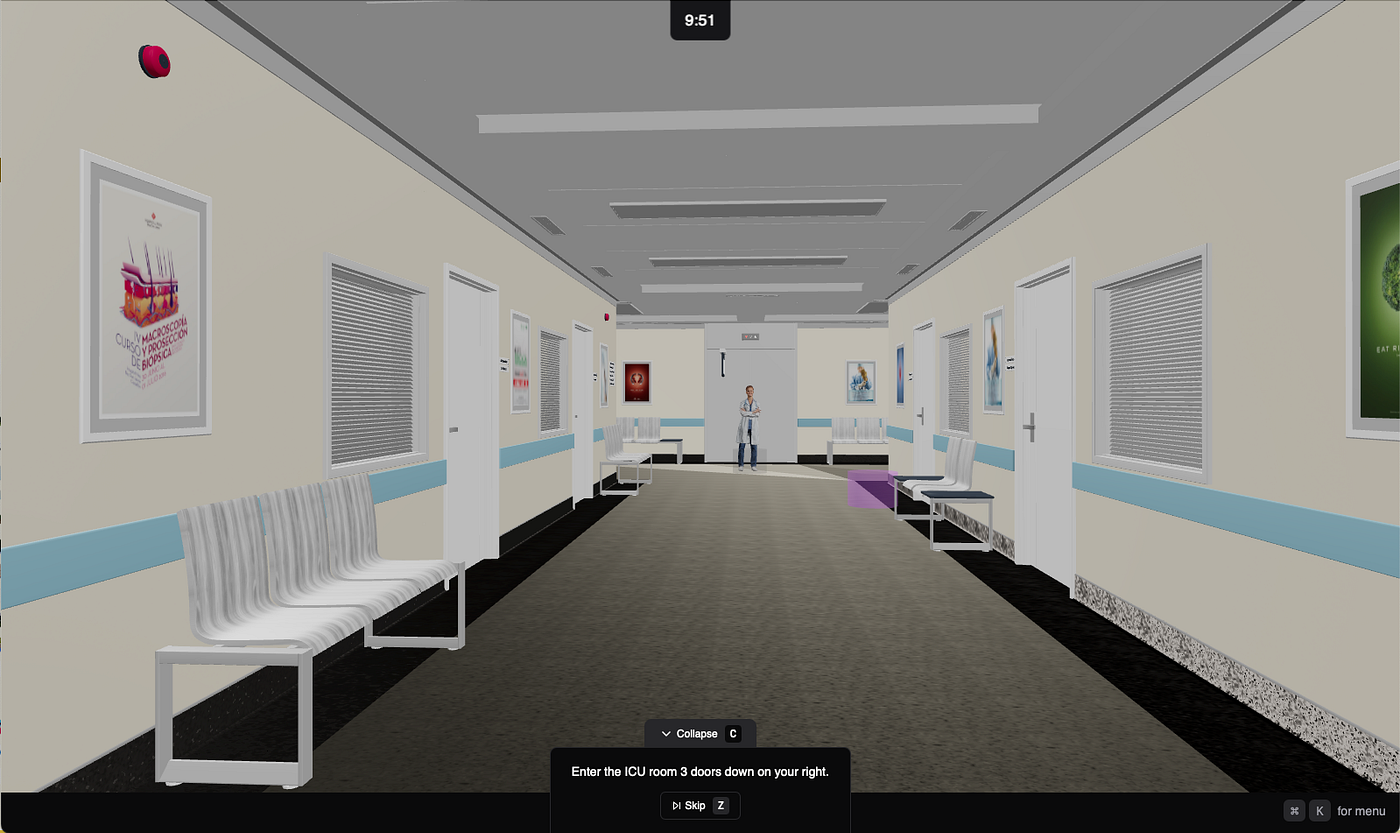
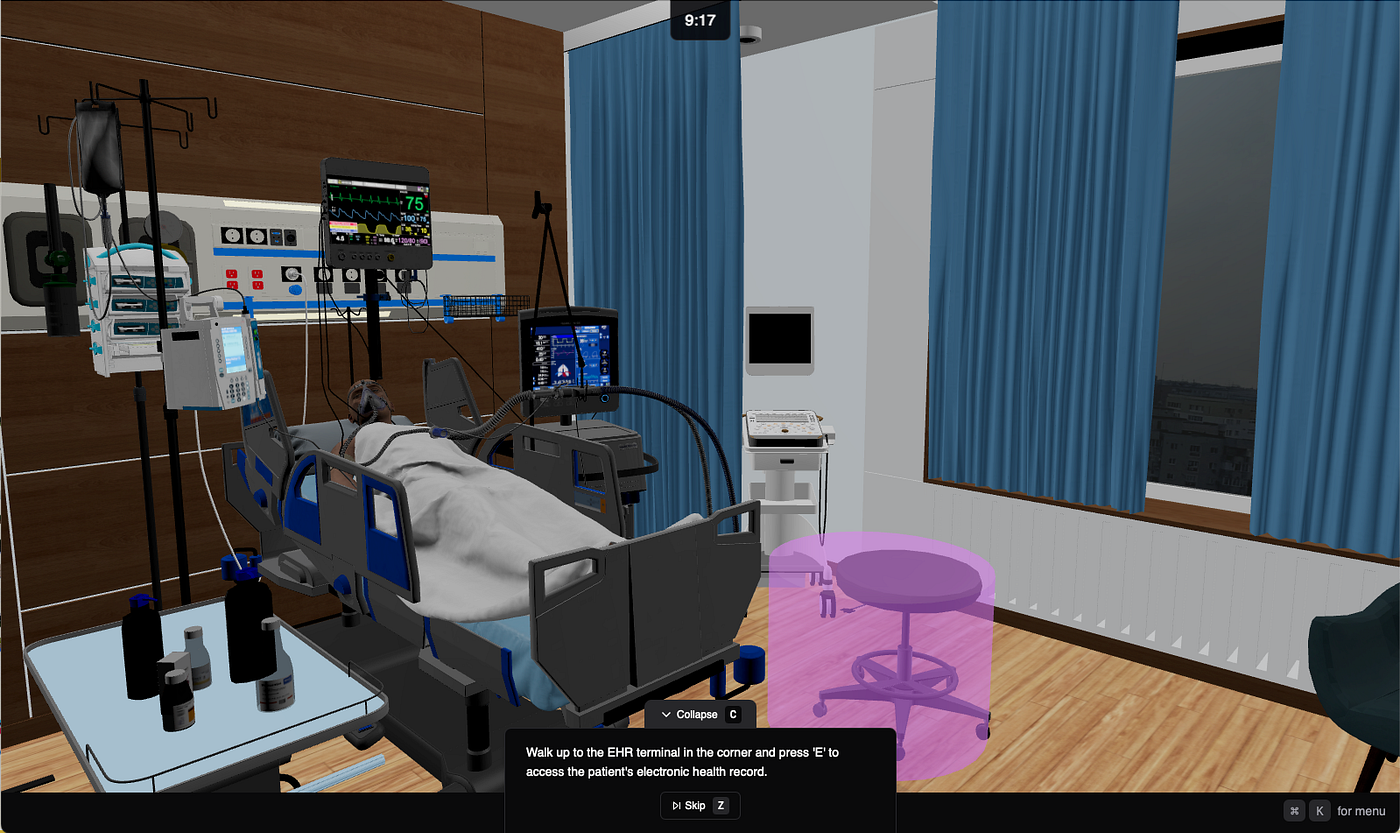
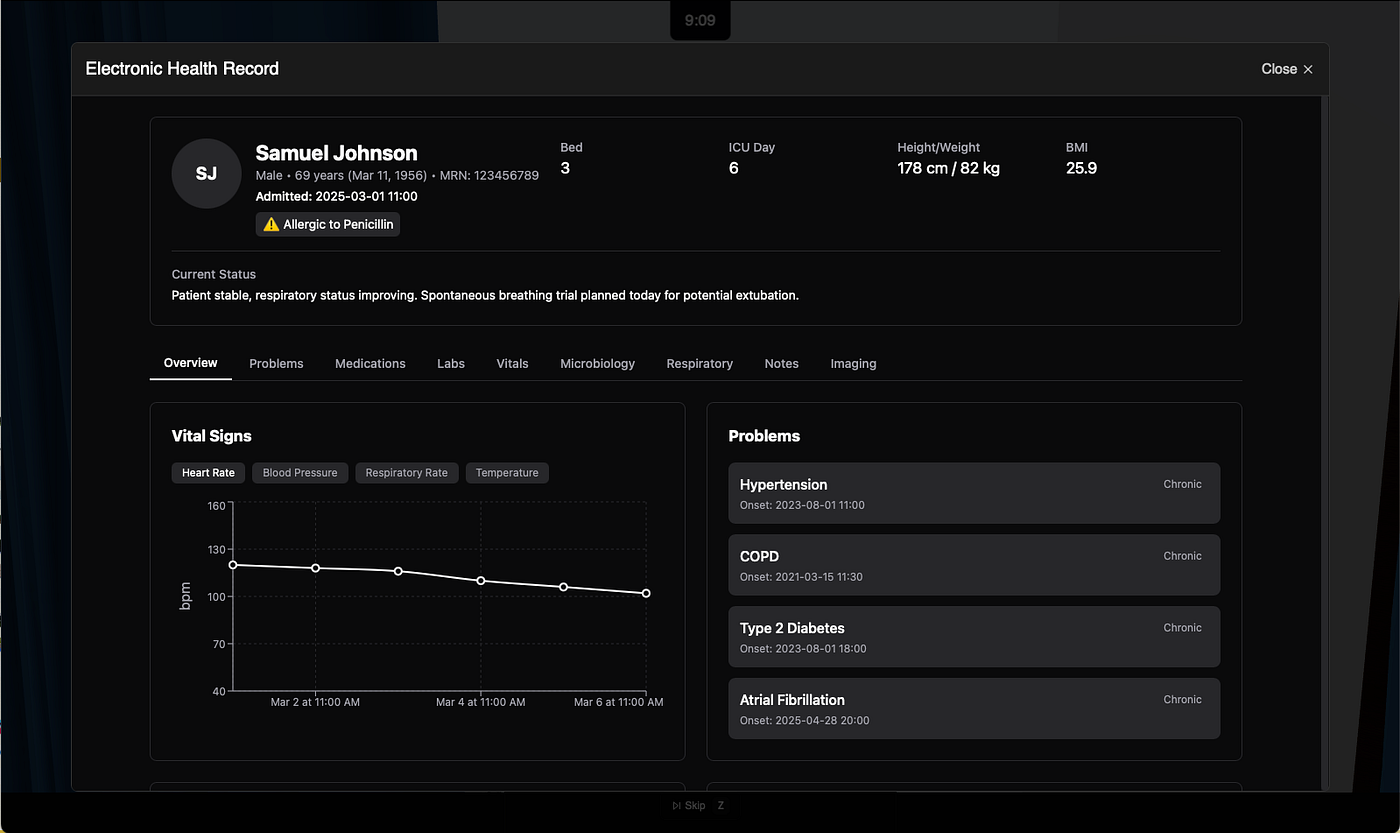
Once in the patient room, they can view the Electronic Health Record, recreated using HTML to embed specific case information directly into the simulation.
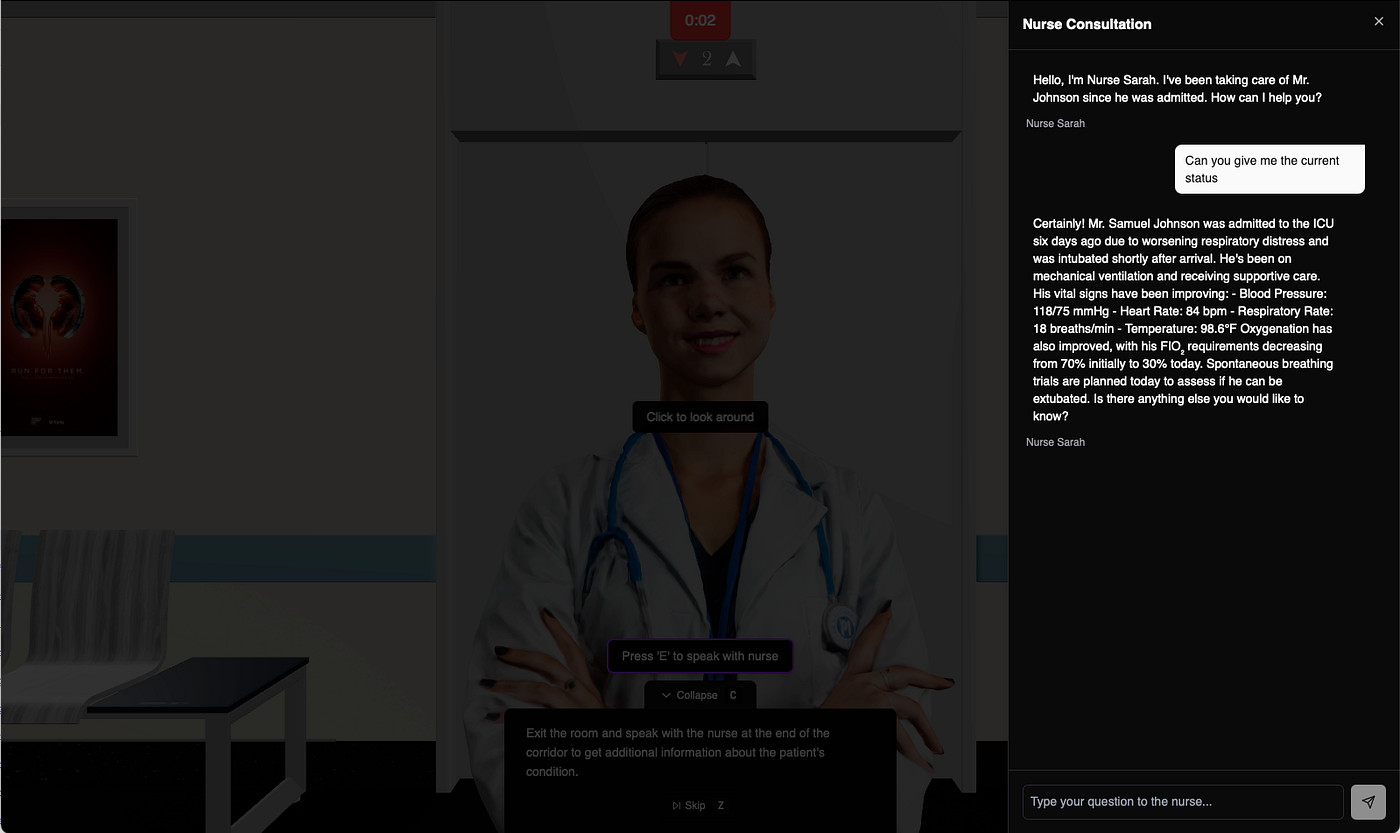
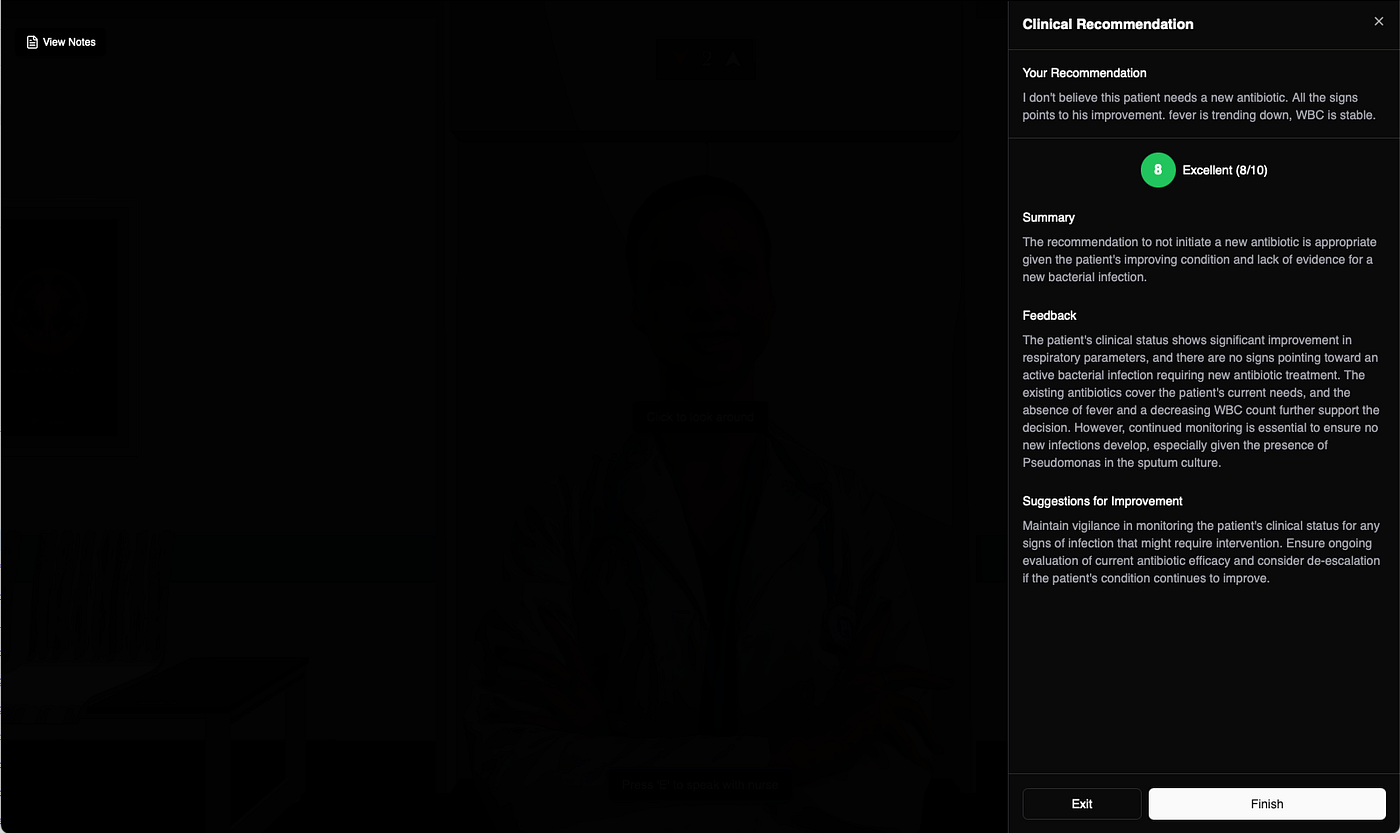
One of the biggest shifts to our design came during user testing. Students told us they wished they could see what would happen if they made the wrong choice, something that's harder to simulate with traditional teaching methods. That feedback inspired two new features: an AI-powered nurse who responds to student questions in real time, and a feedback system that uses an LLM to evaluate the student's clinical plan and provide a tailored response. These elements added a layer of reflection and realism that quickly became some of the most valuable parts of the experience.
Results
After testing this on real users, pre- and post-module surveys showed measurable gains in confidence, accuracy, and self-awareness:
What students said
Asked what they felt more confident doing after using the module, students said they felt more confident:
"Taking the necessary steps before making a final decision."
"Navigating a patient chart and pulling out the relevant patient information."
"Choosing the right antibiotic."
"Picking the right medication, because the module corrects you."
"Defending reasoning for clinical recommendations."
"Interacting with different medical devices."
Students aren't just reading or clicking through a static case anymore. They're moving through a space, gathering data, and getting real-time feedback.
Try the simulation for yourself at rxreality.com.
UX research report
The full study, in its original form.